Journaling gives your mood data context. A score can show that something changed, but a journal entry can explain why it mattered.
Choose a journal type
Mind Wobble includes several journal formats:
- 5 Minute Journal for quick gratitude and intention setting.
- Bullet Journal for rapid lists and planning.
- Journaling with Prompts for guided reflection.
- Stream of Consciousness for unfiltered writing.
- One Line a Day for a short daily record.
- CBT Thought Record for identifying and reframing thoughts.
- Gratitude Journal for appreciation and positive focus.
- Unsent Letter for processing something you do not plan to send.
- Standard Journal for free-form writing.
Pick the format that matches the situation. You do not need to use the same format every time.
Write and save an entry
Open Journal, choose a type, write your entry, then save it. Some journal types include extra tools, such as prompts or a timer.
Use the standard journal when you already know what you want to say. Use prompts when you feel stuck.
Use prompts well
Prompts are most useful when you answer honestly and specifically. If a prompt is not relevant, choose another one rather than forcing it.
When you have recent mood entries, prompts can become more useful because they have better context about what has been happening.
Review your journaling activity
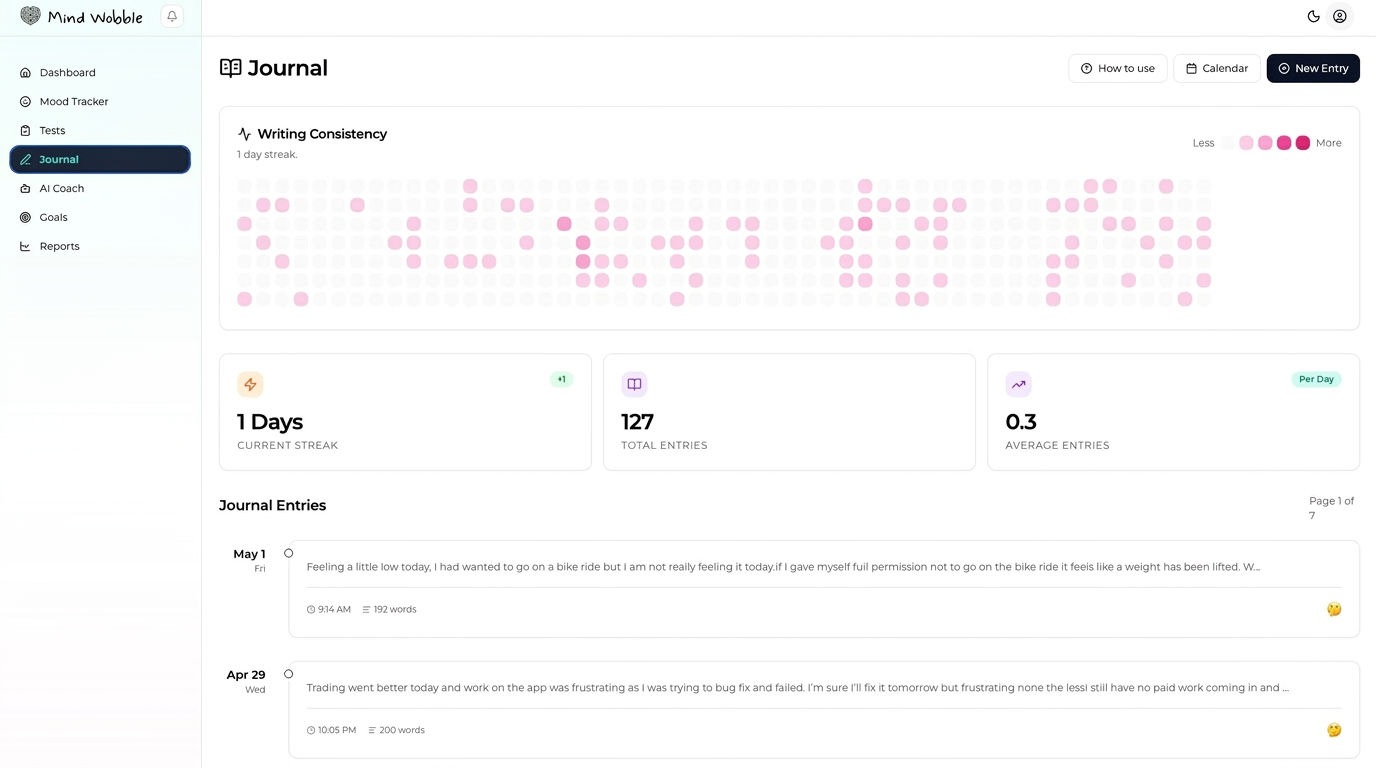
The journal area can show activity over time, including a heatmap, stats, timeline, and calendar view. Use these views to notice consistency and return to important entries.
How journaling connects with the app
Journal entries can help:
- Explain mood tracker patterns.
- Give coaching conversations more context.
- Turn vague worries into clearer thoughts.
- Capture progress on goals.
- Create a record of what helped during difficult periods.
Frequently asked questions
Are my journal entries private?
Yes. Journal entries are encrypted at rest with a per-user key, and only you can read them in the app. They are not shared with other users, and AI providers used by the app cannot use your entries to train their models.
Which journal type should I choose?
Pick the format that matches the situation. Use the 5 Minute Journal when time is tight, Stream of Consciousness when you need to offload, CBT Thought Record when a specific thought is bothering you, and the Standard Journal when you already know what you want to say. You can switch between formats from one entry to the next.
Can I edit or delete an entry after saving?
Yes. Entries can be revisited, edited, or removed from the journal area. Use edits for clarity and corrections rather than rewriting the past.
How long should an entry be?
Long enough to capture what mattered, short enough that you actually finish it. A single honest sentence often beats a forced page.
Do I have to journal every day?
No. Journaling is most useful when you have something to process. Daily journaling can help build the habit, but skipping a day does not break the system or lose your previous entries.