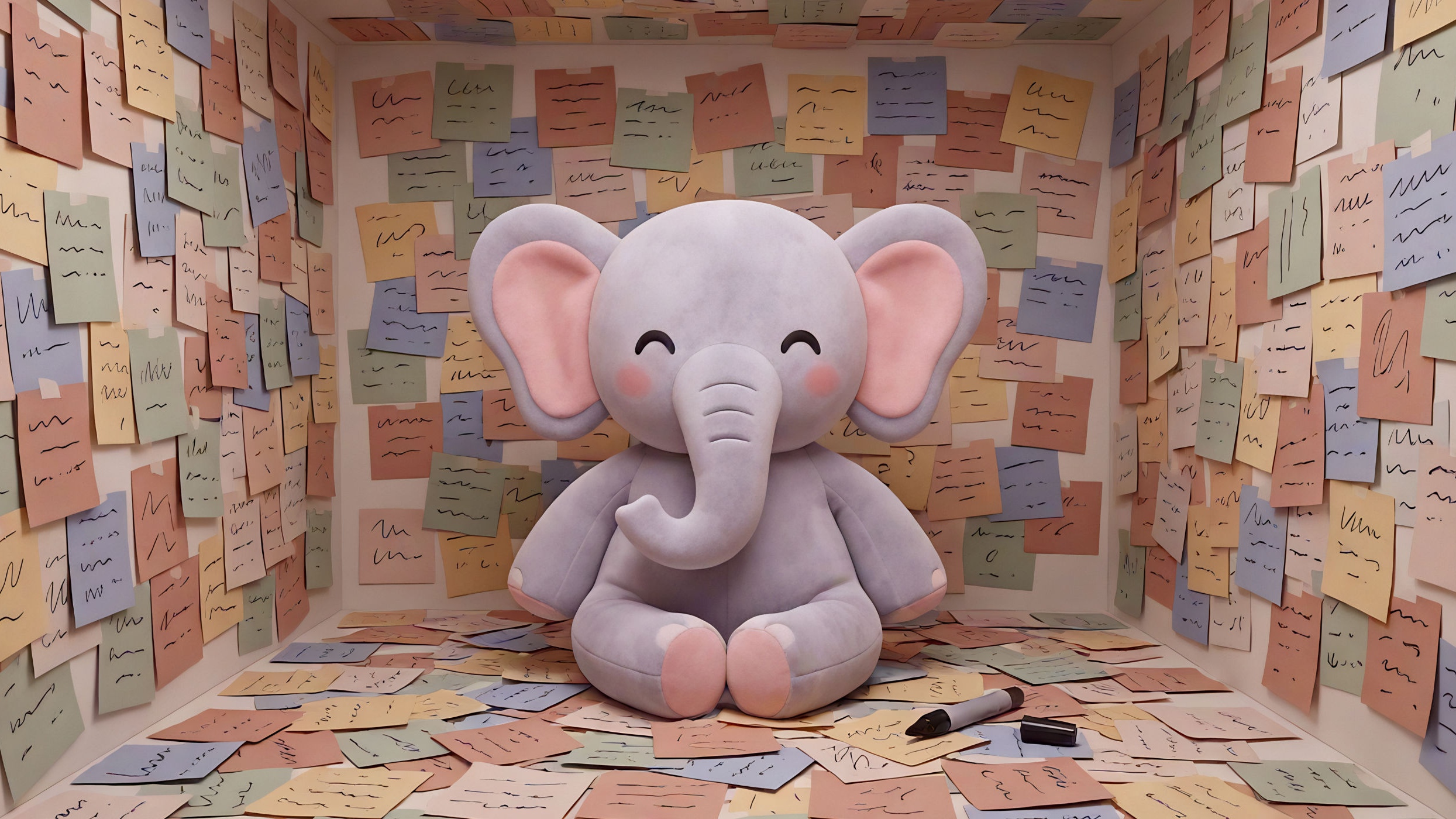
You are halfway through unloading the dishwasher when it arrives. The email you forgot to send. Then, riding in on its coattails, the dentist appointment you have not booked, the friend whose message you left on read for eleven days, and a sudden, uninvited memory of something socially catastrophic you said in 2017. You are holding a wet mug. Nothing has actually happened. And yet your chest has tightened and your brain has gone from "unloading the dishwasher" to "everything, all at once, forever."
This is not a character flaw. It is a storage problem.
Your Brain Is Not a Filing Cabinet
We treat our minds as though they were built for archiving. They were not. Your brain is superb at generating ideas, spotting threats, and making connections. It is embarrassingly bad at holding things still.
The rough consensus in cognitive psychology is that working memory, the mental workbench where you keep things you are actively using, holds far less than we assume. Nelson Cowan's much cited reconsideration of mental storage capacity puts the figure at around four chunks of information at once, not the seven of popular folklore. Four. That is your desk space. And you are currently trying to run a household, a job, a body, several relationships and an inner life on it.
So what happens to everything that will not fit? It does not politely queue. It circles. It comes back at you in the shower, at traffic lights, at the exact moment your head hits the pillow. The mental noise you experience as anxiety is often not a signal that something is wrong. It is a signal that something is unfiled.
A brain dump is the filing.
What a Brain Dump Actually Is (and What It Isn't)
The premise is almost insultingly simple. You sit down with paper or a blank document, you set a timer, and you write down every single thing that is currently taking up space in your head. Tasks, worries, half-formed ideas, resentments, the name of that programme you keep meaning to watch. No order. No categories. No editing. You are not composing; you are evacuating.
It is worth being clear about what it is not, because the term gets stretched to breaking point online.
A brain dump is not a to-do list. A to-do list is a curated, prioritised set of commitments. A brain dump is the unsorted heap you make the list from. Confusing the two is why people end up with a to-do list that quietly triples in length and then makes them feel worse.
It is not gratitude journaling, or morning pages, or a diary. Those are practices of reflection with their own merits. A brain dump has one job: getting the contents of your head out of your head.
And it is not therapy. It is a low-cost strategy for mental clutter, not a treatment for a mental health condition. If your thoughts are relentless, distressing, or frightening you, a notebook is not the right tool and you deserve better support than a biro.
The Zeigarnik Effect: Why Unfinished Things Refuse to Shut Up
In the 1920s, the Soviet psychologist Bluma Zeigarnik noticed something curious about waiters. They could hold enormous, complicated orders in their heads with perfect accuracy, right up until the moment the bill was paid. Then the order vanished from memory entirely, as though someone had pulled a plug.
Her conclusion, which now bears her name, was that unfinished tasks occupy the mind in a way finished ones do not. Completion releases the memory. Incompletion keeps it live.
Fast forward eighty odd years and this idea got a significant, and rather more useful, upgrade. In a paper with the excellent title Consider It Done!, researchers E. J. Masicampo and Roy Baumeister ran a series of experiments in which people were given goals they could not complete, then asked to do something unrelated, such as reading. The people with dangling goals struggled. Their attention wandered back to what they had not finished. They reported intrusive thoughts about it. Their reading suffered.
Then came the interesting part. When participants were asked to make a specific plan for how they would finish the unfinished thing, the interference largely disappeared. Not because they had completed the task. They had not touched it. But because they had written down how and when they would.
Read that again, because it is the whole mechanism. The brain does not need the task done. It needs to know the task is not going to be forgotten.
Think of it like a smoke alarm with no off switch. It will keep shrieking until someone acknowledges it, and it does not particularly care whether the fire has been dealt with. It just wants to know that somebody is on it. A brain dump is you walking over, looking the alarm in the eye, and saying: noted, it is on the list, you can stop now.
What Happens When You Write It Down
Cognitive scientists have a rather unromantic name for this: cognitive offloading. It is defined, in work by Evan Risko and Sam Gilbert, as using physical action to reduce the information processing demands of a task. Writing a shopping list is offloading. Setting an alarm is offloading. Sticking a note on the door so you remember your gym kit is offloading.
The evidence here is fairly consistent: shifting information out of your head and onto something external reliably improves performance, and the advantage grows as the load grows. Which is to say, offloading helps most exactly when you are most overwhelmed. That feels like a design flaw in humans and a gift to anyone with a notebook.
But the mental health case for brain dumping rests on something more specific than efficiency, and the most persuasive single piece of evidence comes, of all places, from a sleep laboratory.
Science Spotlight: The Five Minutes That Bought Nine Minutes of Sleep
Michael Scullin and colleagues at Baylor University took 57 healthy young adults and wired them up for a full night of monitored sleep. Before lights out, each person spent five minutes writing. Half were asked to write about everything they had already completed over the past few days. The other half wrote a to-do list of everything they still had to do.
Common sense says the second group should have slept worse. You have just spent five minutes staring at your own backlog. Surely that is the last thing you want swimming behind your eyelids at bedtime.
Common sense was wrong. In the study, published in the Journal of Experimental Psychology: General, the to-do list writers fell asleep significantly faster than the completed-list writers. Roughly sixteen minutes versus twenty five. And there was a detail that turns this from a curiosity into an instruction: the more specific the to-do list, the faster the person fell asleep. Vague lists helped less. Detailed ones helped most.
Nine minutes may not sound like a revolution. But consider what it cost: five minutes and a pen. Very few things in the mental health world offer that exchange rate. And consider what those nine minutes usually contain, which is not restful blankness but the greatest hits of everything you have failed to do.
The researchers' explanation lines up neatly with Masicampo and Baumeister. Writing the list offloads the unfinished business. The completed activities did not need offloading, because they were, by definition, already closed loops.
Brain Dump, Journaling, or Worry Time? Which One Do You Need
These three practices get lumped together and they should not be, because they do different jobs and picking the wrong one is why people conclude that "writing things down doesn't work for me."
Brain dumping is for cognitive clutter. Use it when your head feels crowded rather than sad. The characteristic feeling is fragmentation: too many tabs open, nothing loading properly. Frequency: whenever the noise builds, plus optionally before bed.
Expressive writing is for emotional processing. This is the tradition built on James Pennebaker's research, where people write continuously about a difficult experience and their deepest feelings about it. A review in Advances in Psychiatric Treatment found benefits across a range of psychological and physical outcomes, though it is honest about the fact that the effects are not universal and not everybody responds. Use it when something specific hurts and you need to understand it. This is closer to what most people mean by journaling for mental health.
Worry postponement, sometimes called worry time, is a cognitive behavioural technique where you deliberately defer worrying to a scheduled thirty minute slot later in the day. The evidence is genuinely mixed. A randomised waitlist-controlled trial found worry postponement reduced worry in people with generalised anxiety disorder, while other work has found it performs no better than control conditions. Use it when the problem is recurrent, circling worry rather than volume of tasks.
If you are not sure which you need, try the crude test: is your head loud, or is your heart heavy? Loud, brain dump. Heavy, expressive writing. If it is both, dump first. It is much easier to feel something clearly once you have cleared the debris off the top of it.
Myth vs Fact
Myth: You need a beautiful notebook and a proper routine. Fact: The back of an envelope works. So does the notes app. So does a receipt. The tool is irrelevant; the transfer is the point. The pursuit of the perfect journaling setup is one of the most reliable ways to never journal.
Myth: Writing down your worries makes you dwell on them more. Fact: This is the intuition the Baylor sleep study tested and contradicted. Getting a worry onto paper is not the same as marinating in it. There is a real risk here, but it comes from how you write, not whether you write, and we will get to it.
Myth: A brain dump is just procrastination with stationery. Fact: There is a version of this that is true, and it usually involves colour coding. But a ten minute unstructured dump that ends in three concrete next actions is not avoidance. It is triage. The distinction is whether anything leaves the page.
Myth: If it works, you should feel calm immediately. Fact: Quite often the first few minutes feel worse, because you are looking at the sheer scale of it in black and white for the first time. That is not the technique failing. That is the anaesthetic wearing off.
How to Actually Do One (The Ten Minute Version)
You need paper, a pen, a timer, and a slightly ruthless attitude towards your own perfectionism.
- Set the timer for ten minutes. The constraint matters. Open-ended dumping tends to drift into brooding, and the timer is your handrail.
- Write everything. Tasks, worries, ideas, grudges, the thing you need to google, the conversation you are dreading. If it is taking up space, it goes on the page.
- Do not organise. No headings, no categories, no numbering. The moment you start sorting, you have stopped emptying. Sorting is the next step and it is a different mode of thinking.
- Do not censor. Nobody is reading this. The pettiest item on your list is often the one that has been quietly humming for months.
- Write in fragments. "Mum birthday??" is a complete and valid entry. Prose is not required.
- When it slows, push once. The last things to surface are usually the heaviest. Sit with the blank moment for thirty seconds before you stop.
Ten minutes. That is the entire technique. The complicated bit comes next, and it is the bit almost everyone skips.
What to Do With the Mess Afterwards
An unprocessed brain dump is just a list of everything wrong with your life, which is a genuinely terrible thing to leave lying around. The relief does not come from the emptying alone. It comes from the emptying plus the promise, which is the bit that satisfies the smoke alarm.
Go through the page and sort every item into one of four buckets.
- Do it now. Anything that takes under two minutes. Send the text. Book the thing. Do it before you finish sorting.
- Diary it. Anything that needs a specific time. Give it a date and a slot, not a vague "next week". Specificity is what made the sleep study work, and it is the same principle behind time blocking to reduce stress.
- Bin it. Be honest. Some of these are not going to happen and have been decorating your mental hallway for three years. Cross them out with a violence that will surprise you. There is a specific pleasure in killing a task that has been quietly judging you since 2023.
- Not a task. This is the bucket that matters most, and the one people forget. A lot of what surfaces in a brain dump is not a job at all. It is a feeling, or a fear, or a piece of grief wearing a to-do list costume. "Sort out the situation with Dad" is not a task. It is something that needs feeling, or talking about, or expressive writing, and pretending it is an admin item is precisely how it stays stuck.
That fourth bucket is where a brain dump stops being a productivity trick and starts being a mental health one. You are not just tidying your schedule. You are separating what needs doing from what needs feeling, which is a distinction that most anxious brains have completely lost the ability to make.
When Brain Dumping Backfires
You have filled three pages. You feel wrung out, not lighter. And somewhere around page two, the list stopped being about tasks and started being about you.
Honesty matters more than enthusiasm here, so here is the failure mode.
Writing about your problems can shade into rumination, and rumination is not benign. Researchers distinguish between two flavours of it. Brooding is passive, repetitive dwelling on how bad things are and how far you fall short. Reflection is a purposeful turning inward to solve a problem. The psychometric work of Treynor, Gonzalez and Nolen-Hoeksema found that these two components pull in opposite directions: brooding predicts depressive symptoms over time, while reflection does not carry the same cost.
A brain dump is supposed to be reflection. It becomes brooding when:
- The page becomes a list of your inadequacies rather than a list of items.
- You write the same thing repeatedly, with increasing heat, and feel worse rather than lighter.
- You never sort it. You just dump, feel briefly cathartic, and dump again tomorrow. This is not offloading; this is pacing the same corridor with a pen.
- You finish and have no next action, only a sharpened sense of doom.
The safeguards are the timer, the sorting stage, and one honest question afterwards: do I feel lighter or heavier? If the answer is consistently heavier, stop. The technique is not for you at the moment, and forcing it will not help. That is worth taking to a therapist rather than to a fresh notebook.
Building It In Without It Becoming Another Chore
The irony of any mental health practice is that it can become one more thing you are failing at, which rather defeats the purpose.
So do not commit to a daily habit. Commit to a trigger.
The Sunday dump. Ten minutes before the week starts, when the mental backlog is at its most vocal. This is the one most people find sticks.
The bedtime dump. Five minutes, specific, task-focused. This is the Baylor protocol, near enough, and it is the one to reach for if your particular problem is that your brain clocks off several hours after you do.
The emergency dump. No schedule. You do it when you notice the specific feeling: crowded, scattered, unable to start anything because you are aware of everything. Keep the means to do it within reach so that the barrier is close to zero.
Some people find the practice pairs well with a quieter one, and there is a reasonable argument that learning to sit with a busy mind and learning to empty it are two halves of the same skill. But that is optional. The dump alone is enough.
Start Here, Tonight
You do not need to read anything else, buy anything, or wait for Monday.
Tonight, five minutes before you get into bed, write down everything you have to do tomorrow. Be specific. Not "work stuff", but the actual thing, with the actual name of the actual person you have to email. Then put the paper down, out of sight, and get in bed.
That is it. That is the whole intervention. The unfinished business is not finished, but it is witnessed, and it is written down, and it is not going anywhere without you.
The alarm has been acknowledged. It can finally, blessedly, shut up.
Frequently Asked Questions
How long should a brain dump take? Ten minutes is a sensible ceiling for a general dump, and five minutes is enough for a task-focused one before bed. Longer sessions tend to slide into brooding rather than clearing.
Should I do a brain dump on paper or on my phone? Whichever you will actually use. Paper has the advantage of no notifications and no temptation to start organising it into a system, which is a very effective way of avoiding the thing you were meant to be doing.
Is it normal to feel worse straight afterwards? Briefly, yes. Seeing the full inventory can be confronting. What matters is how you feel once you have sorted the items into actions, dates, deletions and feelings. If you consistently feel worse rather than lighter, the practice may not be right for you at the moment.
Can a brain dump help with anxiety? It can help with the specific type of anxiety that comes from cognitive overload, where too much unfiled information is competing for too little working memory. It is not a treatment for an anxiety disorder, and it is not a substitute for professional support.
What is the difference between a brain dump and journaling? A brain dump empties. Journaling explores. A brain dump is unsorted and fast and often ugly. Journaling is reflective and, at its best, curious. Many people find they need both, at different times, for different reasons.